
The IATF would like to officially announce a clarification to our definition of league sanctioned target designs.
While flatboard construction is the recommended standard, we are happy to include end-board constructed targets, stumps, or targets created via projector, only so long as these targets strictly conform to the IATF guidelines regarding the placement and measurements of the target rings and Clutches, as well as being positioned the appropriate distances and heights from our sanctioned throwing and safety lines.
We felt this clarification appropriate given the strains certain clubs have been under to meet the letter of our league standards while simultaneously confronting supply chain issues and rising material cost over the past two years.
If any organization or thrower has further questions, please consult the official IATF rulebook here.
The International Axe Throwing Federation (IATF) employs the Collins Rating System to rate players. This system is based on the Elo rating system widely used in chess, online gaming and other kinds of head-to-head competition. The system considers the level of stakes at hand as well as the value of one-on-one competition, and has been adapted by the IATF to accommodate the complexities of axe throwing. The Elo system was selected because it ranks players in head-to-head competition through a mathematical equation.
This system works well for the IATF. We value head-to-head competition, both in our sport and as sports fans, and see the value in a rating system that rates players according to skill and skill improvement. We operate in the spirit of fairness in competition; all venues operate differently, but still have an accurate system of rating for throwers across all IATF organizations.
Key Principles
- Head-to-head competition should be used to assess skills and determine ratings. (true since version 1.0)
- Beating lower rated players is less valuable than beating higher rated players. (true since version 1.0)
- Higher levels of competition should raise the stakes by allowing larger adjustments, if required to better reflect players’ relative skill. ie. IATC has higher stakes than Regionals which in turn has higher stakes than league playoffs. (true since version 1.0)
- Throwing an 81 and winning the tiebreaker should never result in a downward adjustment (this became clear from version 1.0)
- Throwing more frequently should not disproportionately inflate ratings (true since version 1.0, however version 1.1 created a deviation from this principle, version 1.2 addresses the inflation from version 1.1)
Reviewing How it Works:
Players start with an initial rating of 1450.
Each players’ rating goes up or down at the end of a match based on the result of each round. Players have their rating compared to the rating of their opponent. If the higher rated player wins, as expected, adjustments are generally small. However, if the lower rated player wins, an adjustment in ratings moves both players' ratings - up for the lower rated player, and down for the higher rated player.
It should be noted that the first 28 matches a player completes in their career have an additional consideration, specifically, opponents’ ratings in these 28 matches are not adjusted unless the match is also one of the opponents’ first 28 matches. This prevents the uncertainty of new players’ ratings from affecting their opponents’ ratings in their first career season.
CRS 1.0 - The first version of CRS adjusted players rating based on winning or losing rounds within a match. These adjustments were affected by the ratings of their opponents as well as the expected result going into the match.
For example, in version 1.0 (example A): Alice and Bob are throwing a match. Alice is a higher rated player than Bob. When Alice wins the match, her rating goes up slightly and Bob’s goes down slightly, by the same amount. However, if Bob (as the lower rated player) were to win the match, his rating would go up and Alice’s rating would go down, again by the same amount.
Another example (example B): A highly rated player who ties a lower rated player at 81 and wins the tiebreaker. Based on their rating before the match, the lower rated player has exceeded their expectation by taking the match to a tie breaker, and needed an upward adjustment. Since in CRS 1.0 the adjustments were always equal, but opposite, the higher rated player’s rating would be adjusted downward to match the lower rated player’s increase after the match. The result of which was that the two players were now more closely rated, which was the desired result of the system.
Transition to Version 1.1 - After listening to feedback from the community and observing how the System worked in a live setting, it was clear that the rating calculation was not performing as desired in some match scenarios. It was determined that the cause was that ties at 27 were being treated in the same manner as other ties, which, since this is the maximum score, felt like a penalty for the higher rated player, as outlined in example B, described in the previous paragraph. The natural question was “How could I have done better? Why would my rating go down in that scenario?”
Version 1.1 - To address how ties at 27 were impacting rating adjustments, a modification to the calculation was made to treat these rounds as a win in that round for both players instead of a tie in that round for both players; the rationale being neither player could have done better, so this should count as a win. This meant that in matches with ties at 27, it was now possible for both players to be adjusted positively since both players threw as well as possible in that round. This effectively created new “bonus” rating points, adding them to the system. It also meant that the lower rated players’ adjustments were greater than the higher rated players’.
This modification created a new issue wherein players who were tying at 27 more frequently, especially by throwing in multiple leagues, were receiving a disproportionate boost to their ratings since these “bonus” rating points threw off the original balance of the system. This effect was more pronounced for the lower rated players.
For example, in version 1.1 (example C): Alice and Bob are both rated 1600. Alice and Bob both throw 27s at the same percentage rate, however, Alice throws in one league and Bob throws in four leagues. Bob stands to gain four times the “bonus” rating points.
Following the release of Version 1.1, after listening to community feedback and observing actual match rating adjustments, it was clear that another modification would be needed to align the CRS to some key principles.
Version 1.2 (since July 17, 2020)
A modification to the calculation was made that would treat ties at 27 as follows:
- The higher rated player’s round is treated as their expected result in the round. This means that it is no longer possible to tie at 81 and win the tiebreaker and have the rating adjusted downward.
- The lower rated player’s round is treated as a tie in the round (as with Version 1.0). It should be noted that a tie for the lower rated player is better than expectation. This means that throwing an 81 against a better player can result in a positive adjustment, even if the tie breaker is lost. However, it also avoids the inflated rating adjustments of Version 1.1.
For example, in version 1.2 (example D): Alice and Bob play a match. Alice is rated 1700 and Bob is rated 1500. Alice is expected to win. They both throw three rounds of 27 and tie overall at 81. Alice wins the tiebreaker.
The resulting rating adjustment for each of the CRS versions would be (see The Full Nerd Version below):
CRS Version | Alice | Bob |
1.0 | -3 | +3 |
1.1 | +5 | +10 |
1.2 | +1 | +3 |
For those interested in a more detailed understanding of the rating adjustments calculation, please see The Full Nerd Version below.
Hello everyone,
Since the debut of our Premier Ruleset we’ve paid close attention to the feedback from our Premier League players as well as the rest of the axe throwing community. While Premier Leagues have accomplished several of the key goals we identified when constructing the ruleset, we believe that no ruleset is free from the ability to grow and improve.
The move from majority scoring to ‘no bleed’ scoring for standard throws was a logical progression for our more advanced throwers competing in Premier Leagues, and the shrinking of the clutch to 2 inches on all targets was shown to be necessary in both Standard and Premier streams where ‘going for clutch’ was beginning to lose its sense of challenge.
While our clutch requirements for Premier have had the desired effect in regards to bringing successful clutch attempts made by high level players down, making them harder to hit and, therefore, more exciting to achieve, measuring these clutches has taken away a sense of spectacle and immediacy from the final throw of each round and affected the pace and flow of premier rules matches.
With that said, we are happy to announce an amendment to this rule and an addition to our clutch design to alleviate this issue moving forward. A 1 inch wide, 1.5 inch tall vertical rectangle will be drawn inside the center of each clutch. To achieve a Premier Clutch, a player’s axe must now come to rest with the blade breaking the top and bottom of this rectangle on the surface of the target.
Best practices for drawing these stripes, recommended equipment, and stencil offerings can be found here and this information has been relayed to all IATF member organizations. This rule will go into effect officially at the beginning of the 2022-2023 Season in March, however, clubs may institute these changes early for their Premier Leagues competing this year if they so wish.
PREMIER CLUTCH ADJUSTMENT
We are happy to announce an amendment to the Premier clutch rule and an addition to our clutch design to alleviate the issue of easy clutch measurements moving forward.
A 1 inch wide, 1.5 inch tall vertical rectangle will be drawn inside the center of each clutch. To achieve a Premier Clutch, a player’s axe must come to rest with the blade breaking the top and bottom plane of this rectangle on the surface of the target.
While this rule will come into effect as of the beginning of the 2022-2023 IATF League Year in early March, 2022, clubs are welcome to implement it earlier for their 2022 Premier Leagues.
CLUTCH BOX MEASUREMENTS DIAGRAM

HOW TOS AND BEST PRACTICES
First, while venues are welcome to create their own stencils in the interim, it’s important to note that we will be partnering with Warriors Axe Throwing to provide updated stencils for purchase prior to our March kick-off date. These stencils will be available through both IATF.com and the Warriors shop and are available to ship worldwide.
- To Draw the Clutch Box
- Employ either your own, hand-made stencil or one purchased directly from the IATF or Warriors (stencils being the fastest and most accurate way to draw the clutch box on the fly).
- Use white (or light colored), oil-based paint markers instead of standard acrylic (oil based paints show up more clearly on painted clutches and won’t run).
- Place the stencil firmly on a dry clutch so that it won’t shift while painting (do not attempt to draw a clutch box on a wet or damp clutch, whether from being recently painted or recently sprayed with water).
- Solidly trace the edges of the stencil with the marker before filling in the center (do not squeeze too much paint from the marker nib when tracing the edges as that paint may bleed underneath the stencil).
- Remove the stencil and check your work (should a minor divot or bend be present, use either the clutch box marker or the clutch marker to touch up these issues).
- Adjudicating New Premier Clutches
- Gauge whether the axe blade has ‘broken’ (ie; is protruding above and below) both the top and bottom horizontal planes of the clutch box as observed from the surface of the target (see diagram above with the planes marked ‘a.’ and ‘b.’)
- If the axe has broken both these planes, this clutch attempt succeeds and the player scores 7 points.
- If the axe has broken one plane but fallen short of the other, this clutch attempt fails and the player scores 0 points for that throw.
- If the axe has broken neither plane, this clutch attempt fails and the player scores 0 points for that throw.
- League staff or match officials are encouraged to use phone camera zooms or flashlights to provide clarity if a clutch is difficult to judge.
- If the axe has landed to the left or right of the clutch box and seems to run parallel to the edge of the box but players are unsure if the axe has broken either plane, league staff or match officials may remove the axe to ascertain if the axe has ‘folded in’ white from clutch box itself.
- If white paint is visible in the cut the axe made as the staff or official is removing the axe at both the top and bottom plane of the box, this clutch is successful and the player scores 7 points.
- If there is no white paint visible or only white paint visible at either the top or the bottom plan of the box (but not both planes) this clutch attempt fails and the player scores 0 points.
FAQs
What prompted the change?
We spent the months following our announcement of the official rulebook changes in April, 2021 compiling data from Axescores, speaking to venue operators, and listening to our community of throwers. While the majority of the original rule changes we implemented accomplished the goals we prioritized last year, this specific rule had both pros and cons which we felt necessitated revisiting.
What were some of the reasons behind the original clutch rule change?
A majority of players and member organizations polled prior to the change agreed that any advanced ruleset needed to be more difficult in all facets of the game, not just for regular throws but also for clutch attempts.
With that in mind, we wanted to introduce a rule that wouldn’t require venues to have multiple clutch designs (ie; not a separate target design for Standard and one for Premier), that would be robust enough to withstand several rounds of competition (ie; not a tiny or intricate clutch that could be destroyed immediately after a few throws), and require a high level of skill to achieve (ie; difficult enough to inject excitement and uncertainty into the final throw of a round while not instantaneously becoming easy for the community after a few months of practice).
Why is this better than the original rule?
While the original Premier clutch rule accomplished the goals outlined above there were still some minor issues in this mechanic uncovered over the past few seasons, those being;
a) the lack of a visible marker to aim for when attempting a Premier clutch,
b) the loss of an instant, visual indicator of success, and
c) the necessity for time consuming measurements during the most high stakes portion of the game.
While individually these issues were small, together they were contributing factors for us to decide to make this new adjustment. We believe this new rule change addresses all of these concerns in a simple and concise fashion which also does not require a complicated management process to implement.
Looking at the dimensions of the box, does that make it harder or easier than the original Premier clutch rule?
When designing a scoring feature like the Premier scoring box, we look at scorable area. Based on a direct comparison of the original proposed Premier clutch (ie; the “1.75 inches of blade” rule), this new feature has an almost equitable amount of scorable area. Therefore neither game mechanic is easier or harder, one is simply clearer and less time consuming.
- If the axe has landed to the left or right of the clutch box and seems to run parallel to the edge of the box but players are unsure if the axe has broken either plane, league staff or match officials may remove the axe to ascertain if the axe has ‘folded in’ white from clutch box itself.
- If white paint is visible in the cut the axe made as the staff or official is removing the axe at both the top and bottom plane of the box, this clutch is successful and the player scores 7 points.
- If there is no white paint visible or only white paint visible at either the top or the bottom plan of the box (but not both planes) this clutch attempt fails and the player scores 0 points.
FAQs
What prompted the change?
We spent the months following our announcement of the official rulebook changes in April, 2021 compiling data from Axescores, speaking to venue operators, and listening to our community of throwers. While the majority of the original rule changes we implemented accomplished the goals we prioritized last year, this specific rule had both pros and cons which we felt necessitated revisiting.
What were some of the reasons behind the original clutch rule change?
A majority of players and member organizations polled prior to the change agreed that any advanced ruleset needed to be more difficult in all facets of the game, not just for regular throws but also for clutch attempts.
With that in mind, we wanted to introduce a rule that wouldn’t require venues to have multiple clutch designs (ie; not a separate target design for Standard and one for Premier), that would be robust enough to withstand several rounds of competition (ie; not a tiny or intricate clutch that could be destroyed immediately after a few throws), and require a high level of skill to achieve (ie; difficult enough to inject excitement and uncertainty into the final throw of a round while not instantaneously becoming easy for the community after a few months of practice).
Why is this better than the original rule?
While the original Premier clutch rule accomplished the goals outlined above there were still some minor issues in this mechanic uncovered over the past few seasons, those being;
a) the lack of a visible marker to aim for when attempting a Premier clutch,
b) the loss of an instant, visual indicator of success, and
c) the necessity for time consuming measurements during the most high stakes portion of the game.
While individually these issues were small, together they were contributing factors for us to decide to make this new adjustment. We believe this new rule change addresses all of these concerns in a simple and concise fashion which also does not require a complicated management process to implement.
Looking at the dimensions of the box, does that make it harder or easier than the original Premier clutch rule?
When designing a scoring feature like the Premier scoring box, we look at scorable area. Based on a direct comparison of the original proposed Premier clutch (ie; the “1.75 inches of blade” rule), this new feature has an almost equitable amount of scorable area. Therefore neither game mechanic is easier or harder, one is simply clearer and less time consuming.
Hello all,
With the new year comes change to the IATF; our Director, Heidi Rich, is stepping down from her role to take on an exciting opportunity outside of our organization. We wish her the best in her new endeavor and want to express our appreciation for her guidance and support over the past two years.
Our Commissioner, Matt Wilson, will be taking on the additional role of Interim Director over the next few months to guide the IATF into the new year.
With that in mind, Ian, Matt and Chris are working hard on some new and exciting developments. So keep your eyes and ears peeled for some exciting announcements coming this Winter and Spring. Stay tuned to our social channels for news and updates!
The IATF is happy to announce several key dates in 2022 for the Road to the IATC and the long-awaited culmination of the 2020-2021 season.
This season will officially end on March 11th, 2022, paving the way for successive IATF seasons to run from early March to early March each year, with the IATC held in Toronto moving to June, a welcome change from our traditional, cold February tournament.
The IATF will also be adjusting certain regional borders to better reflect our league populations. More importantly, we will be redrawing these regions for this season to minimize travel across borders in certain areas and to support league members wishing to travel for regional competitions by limiting additional costs for COVID testing, etc.
A map of the newly drawn Regions for the 2020-2021 Season can be found below.
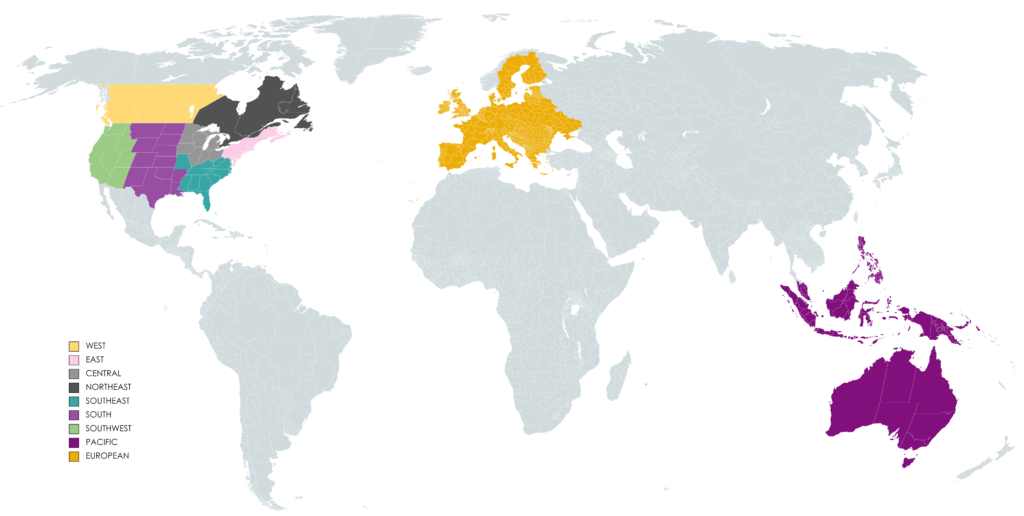
On February 27th, 2022 the IATF will be partnering with 9 of our member organizations to host Regional competitions for any league participants who took part in sanctioned league play in either a Standard or Premier league during the 2020 or 2021 seasons, even partial seasons or seasons at clubs that have since closed. Regional winners are automatically entered into Round 1 of the IATC.
Regional hosts for the 2020-2021 Season are:
West: True North, Red Deer, AB
Southwest: LA Ax, Los Angeles, CA
South: Urban Axes, Austin, TX
Central: Detroit Axe, Detroit, MI
East: Ace Axe, Pittsburgh, PA
Southeast: BATL LoSo, Charlotte, NC
Northeast: BATL Portlands, Toronto, ON
Pacific: Maniax CBD, Melbourne, VIC
European: Skeeters, London, UK
Registration information will be available in the new year so stay tuned.
The weekend of March 18th, 19th and 20th, 2022 IATF members who have hosted a sanctioned Standard or Premier league during the 2020-2021 Season may choose to host a Wild Card tournament (Premier Rules.) This tournament is open to any player who has participated in a sanctioned league in either stream (Premier or Standard) but has not qualified for Round 1 of the 2022 IATC at that point in time (see qualification path here.) Look for announcements from your local club closer to the date for details.
Round 1 of the 2022 IATC will be hosted on April 8th, 9th, and 10th at all participating IATF member locations who held sanctioned leagues in either stream (Premier or Standard) from January 2020 until March 11th, 2022. The full list of those eligible for participation in Round 1 will be available shortly after completion of the 2020-2021 league year in March once we collect the data from each sanctioned league.
Should a location have closed in the interim, their players will be allowed to compete for that club’s vacant spot(s) at their nearest IATF location.
We are as excited as all of you to reach the end of this COVID extended season and we are counting the days until we kick off this year’s International Axe Throwing Championship with Round 1 at your home venues in April 2022. We cannot wait to see you all there.
*dates may be subject to change based on evolving global COVID landscape
1. All participating member organizations will send to IATC Round 2 a number of competitors equal to their percentage of the total IATF league enrollment during the calendar year.
2. The league enrollment is calculated as players in each season.
1. An individual player participating in one season would count as 1, the same player participating in four seasons would count as 4.
3. Only the league members of organizations participating in Round 2 will count towards the member representation in the tournament.
1. For instance, if there are 6000 active league members across all organizations in the IATF, and they all participated in all 5 season through the year, then there would be 30,000 league enrollments in the pool of IATF representation:
1. If organization “Z” represents 10,000 of those league enrollments, and chooses not to participate for any reason, then those 10,000 league enrollments would be removed from the equation;
2. If all other organizations participate, then there are 20,000 league enrollments remaining in the equation;
3. e.g. If organization “A” represents 2,000 league enrollments, then organization “A” would represent 10% of all participating IATF leagues in Round 2;
2. That means organization “A” throwers will represent 10% of those competitor ‘seats’ in Round 2 of the tournament
1. eg. 25 seats would be organization A throwers if the final round hosts 250 total competitors, 10 seats would be organization A throwers if the final round hosts 100 total competitors
2. In the case of a decimal point percentage, the IATF will round up or down accordingly to match the amount of throwers in the final stage.
3. When applying these calculations to any official tournament numbers, keep in mind that 1 spot in Round 2 is reserved for the winner of the previous year’s tournament. Additional spots are reserved for the winners of the Regional tournaments.
1. Format and Seeding
1. Round 2 of the tournament is a double elimination tournament bracket. The rules and format of Round 2 matches continue using the Premier ruleset and scoring system also used to score Round 1.
2. These competitors are the top throwers from each organization as determined by Round 1.
3. The seeding within this round of the tournament is determined by the player’s performance in Round 1.
2. Round 1 of the IATC tournament will be held at all IATF organizations on one set day each year***:
2. Previous Year’s Champion
1. The winner of the previous year’s IATC tournament is guaranteed entry into Round 2 of the tournament, however, will still need to throw in Round 1 for seeding purposes.
3. Attendance
1. If a competitor is late for their first match and misses it, then they automatically forfeit that match and move to the “B” Bracket and their opponent will automatically advance to the next set of matches:
2. If the same competitor who missed their first match also misses their second match in the “B” bracket, they automatically forfeit that match and are eliminated from the tournament.
1. Round 1 of the IATC tournament will be held at all IATF organizations on one set day each year***:
1. All scoring for Round 1 will be based on the Premier ruleset and scoring system.
1. See Premier ruleset in section (1.4.1)
2. All qualifying throwers from every league will throw for Round 1 on the set date, at their home venue.***
2. Round 1 of the IATC tournament will be held at all IATF organizations on one set day each year***:
Format
1. In Round 1 of the IATC, players will be randomly split into groups of four. Players will take to their assigned lane, then throw the equivalent of 5 matches (a total of 75 throws) and 15 Big Axes:
1. In this round, competitors are not facing off one on one against an opponent, as in standard competition, rather, the goal here is to throw for the highest point total possible;
2. Once each group of 4 competitors has taken to their assigned lane, they will throw 15 axes in a row, scoring points under IATF Premier scoring rules.
1. Each thrower must throw for Clutch every 5th throw. Premier Clutch scoring applies.
3. Every 15 axes, scores will be tallied and competitors will move one lane to the right and throw another 15 axes until everyone has thrown 75 times:
1. Competitors on the farthest right lane will move to the far left lane of the arena to score their next throws when necessary;
2. Between every set of 15 throws, competitors can request a board change similar to regulation competition.
3. Every 15 axes, scores will be tallied and competitors will move one lane to the right and throw another 15 axes until everyone has thrown 75 times:
1. Competitors on the farthest right lane will move to the far left lane of the arena to score their next throws when necessary;
2. Between every set of 15 throws, competitors can request a board change similar to regulation competition.
4. Each set of 15 throws will count as the score for 1 match totaling 5 match scores for every competitor. Players will receive the average match score from these 5 matches:
1. e.g. for a competitor’s first set of 15 throws they throw a total match score of 42, in their second set, a 67, in their third set, a 61, in their fourth set 60, and their fifth set another 60. The total scored points obtained over the 5 matches is 290, divided by 5 to obtain an average score of 58.
5. Upon completion of these 75 throws each competitor will throw 15 consecutive big axes.
1. A competitor may call Clutch at any point during their 15 big axe throws.
2. Competitors are not required to score a bullseye prior to being able to call Clutch in these 15 throws
3. Their combined score from these 15 throws will be used as a tiebreaker in the case that throwers have the same Round 1 average as another thrower.
6. Upon completion of this round, competitors will be ranked against others from the same organization based on their Round 1 average and using Big Axe tie breaker score if needed:
1. The Round 1 rank will be used to determine who represents each organization based on the percentage of representation calculation for Round 2 of the tournament (See section 7.1 below)
2. The Round 1 score will also be used to seed a competitor that moves onto Round 2 of the IATC.
***exceptions may be made due to COVID-19
The Championship
The International Axe Throwing Championship (IATC) is an annual event that brings together great players from around the globe to compete for the Wilson Cup.
The Wilson Cup tournament is divided into two Rounds. Round 1 is played at many host venues internationally. The results of Round 1 determine which competitors advance to Round 2 and determine their seeding in Round 2. The format of Round 2 is a seeded double elimination bracket, hosted in Toronto, which takes place over two days in June.
Competing For the Wilson Cup
To compete for the Wilson Cup, competitors must qualify during the Qualification Period prior to the IATC. The qualification period for IATC 2025 is March 9, 2024 to March 7, 2025.
There are two primary ways to qualify: winning selected tournaments and league performance.
Qualification via Tournaments
The previous year’s IATC Champion qualifies for the next Wilson Cup. In addition, they are guaranteed to advance to Round 2, with their seeding determined by their Round 1 results.
On the IATF Integrated Tournament Circuit, winners of Majors and the top 4 finishers from Grand Slams qualify for the Wilson Cup. In addition, they are guaranteed to advance to Round 2, with their seeding determined by their Round 1 results.
Each IATF Region hosts a Regional Axe Throwing Championship in November. The top 2 finishers of these tournaments qualify for the Wilson Cup. In addition, they are guaranteed to advance to Round 2, with their seeding determined by their Round 1 results.
Competitors who qualify via tournaments are removed from consideration for qualification via league performance.
Qualification via League Performance
IATF Member Organization Participation
IATF member organizations host qualifying league seasons (see below) throughout the Qualification Period. Any number of competitors may qualify for IATC by participating in an IATF member organization’s leagues. However, each member organization will advance a limited number of competitors to Round 2. Each member organization will have the opportunity to advance at least one competitor. Additional advancing competitors are determined by the organization’s total league participation as a percentage of the total IATF league participation.
Minimum Player Participation to Qualify
In order to qualify, competitors must participate in at least three league seasons at one IATF member organization within the Qualification Period. These league seasons can be Standard rules or Premier rules seasons.
In order for a season to count toward a player's participation, they must compete in a minimum of 12 matches. These must be played matches, not forfeits.
The Top 8 Rule
A competitor who finishes in the Top 8, by Champs Points (see below), in a Premier rules season qualifies for IATC. Once a competitor meets this qualification criteria, they are removed from consideration for any other league performance qualification.
The 70 Rule
A competitor who achieves an average of 70 or better in three non-concurrent seasons, Standard rules or Premier rules, hosted by one organization, qualifies for IATC. Once a competitor meets this qualification criteria, they are removed from consideration for Standard rules league performance qualification.
The Top 4 Rule
A competitor who finishes in the Top 4, by Champs Points (see below), in a Standard rules season qualifies for IATC.
All qualifiers via league performance compete in Round 1. The results of Round 1 determine which competitors advance to Round 2 and determine their seeding in Round 2.
What is considered a qualifying league season?
Players are considered for IATC qualification if the league seasons in which they participate meet all the following criteria:
The season is hosted by an IATF member organization in good standing
The season is not designated as Recreational
The season has a minimum of 5 competitors
The season is played using either IATF Standard or IATF Premier rulesets
The round robin consists of matches where each player competes in 20-28 matches
The season concludes with a double elimination playoff tournament
What are Champs Points?
Champions Points (Champs Points) are awarded to players at the end of every Standard and Premier qualifying league season, based on where they place at the end of round robin play (see the table below) and additional Champs Points are awarded based on playoff performance (see the table below).
Round Robin Rank | Champs Points |
|---|---|
1st | 16 |
2nd | 15 |
3rd | 14 |
4th | 13 |
5th | 12 |
6th | 11 |
7th | 10 |
8th | 9 |
9th | 8 |
10th | 7 |
11th | 6 |
12th | 5 |
13th | 4 |
14th | 3 |
15th | 2 |
16th | 1 |
Playoff Finish Position | Champs Points |
|---|---|
1st | 8 |
2nd | 4 |
3rd | 2 |
4th | 1 |
Have I Qualified?
Please use the Qualification Flowchart to determine whether you have qualified for IATC.